
Key takeaways
- The 3-minute rule means moisturising your baby's whole body within 3 minutes of leaving the bath. This is when the skin absorbs moisture most effectively.
- Eczema-prone skin loses moisture rapidly after bathing. Without moisturiser applied immediately, bath time can make dryness worse, not better.
- The soak-and-seal method is recommended by paediatricians and leading eczema organisations as the most consistent daily approach to managing eczema-prone skin.
- Apply a lightweight oil first on damp skin, followed immediately by a fragrance-free lotion. The oil prepares the barrier. The lotion seals it.
- Product choice matters as much as timing. Sulphates, synthetic fragrance, and optical brighteners can undo the technique entirely.
Introduction
Your baby has just come out of the bath. Skin is damp, warm, and for a brief window, ready to absorb moisture more effectively than at any other point in the day. What happens in the next 3 minutes determines whether that bath helped or hurt.
The soak-and-seal method, recommended by paediatricians and leading eczema researchers, is one of the most widely recommended baby eczema treatments for home care. This guide covers what the 3-minute rule is, how to execute the technique step by step, what products to use, and which ingredients to avoid.
For the full baby eczema guide, read: Comprehensive Guide to Managing Baby Eczema Naturally.
What is the 3-minute rule for eczema?

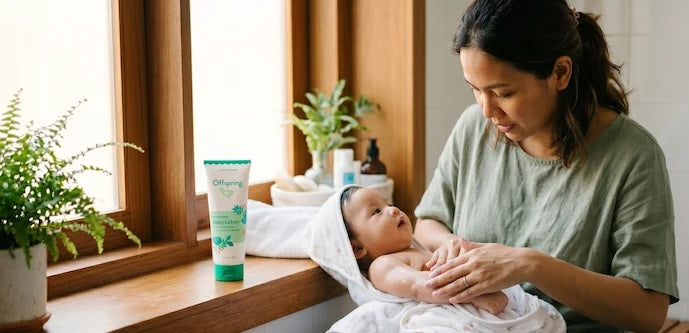
Parent applying moisturiser to a baby's damp skin immediately after bath time.
After a bath, water evaporates quickly from the skin surface, and for eczema-prone skin that moisture loss happens faster than in healthy skin. Moisturising within 3 minutes seals that hydration into the skin before it escapes.
Applying moisturiser within 3 minutes of bathing is recommended as part of the soak-and-seal method for managing eczema in children.
Why eczema-prone skin needs the soak-and-seal method
In babies with eczema, the skin barrier is defective. It cannot retain moisture effectively, which means water escapes faster than in healthy skin and irritants enter more easily.
Without the soak-and-seal technique, bath time can worsen dry skin in babies rather than relieve it, because water that evaporates from the skin surface takes residual moisture with it. When it works as intended, the soak-and-seal method turns each bath into active barrier repair. It is a consistent form of eczema prevention and one of the most practical baby eczema treatments for reducing a baby eczema flare up at home.
Step-by-step: The soak-and-seal bath routine

Baby wash, towel, body oil and lotion arranged for the three-step soak-and-seal eczema routine.
Knowing how to treat baby eczema at home starts with the bath itself. The right technique and the best moisturiser for baby eczema work together. Follow these steps in order. The sequence matters as much as the products.
Daily bathing in warm water for less than 10 minutes is often recommended for children with eczema, immediately followed by moisturiser applied to damp skin.
Step 1: The bath (soak)
- Water temperature: lukewarm only, around 37 degrees Celsius. Hot water strips the skin barrier and triggers inflammation on eczema-prone skin.
- Bath length: 5 to 10 minutes. Long enough to hydrate the skin, short enough to avoid over-stripping natural oils.
- Cleanser: fragrance-free, soap-free, SLS-free. Conventional soap disrupts the skin's natural pH and removes protective oils with every wash.
- Technique: hands or a soft cloth only. No scratching or rubbing on eczema-affected areas. Friction worsens inflammation.
- Frequency: daily bathing is often recommended for babies with eczema, especially in Malaysia's air-conditioned environments where skin loses moisture faster. Skipping baths does not protect the skin.
Offspring Gentle Head-To-Toe Wash is soap-free, SLS-free, and formulated with aloe vera, calendula, and chamomile. It is Australian Allergy Certified and dermatologist and paediatrician approved for sensitive skin.
Step 2: Pat dry, never rub
Immediately after lifting your baby out of the bath, pat the skin gently with a soft, clean towel. Never rub. Rubbing creates friction that irritates sensitive skin and triggers the itch-scratch cycle. Leave the skin slightly damp. This is the critical condition for Step 3.
Step 3: The 3-minute seal
The clock starts the moment your baby leaves the water.
- Apply the body oil first to slightly damp skin before the lotion. Oil applied to damp skin helps retain moisture and prepares the barrier before the lotion seals it in.
- Apply the lotion immediately after, covering the whole body. Thicker formulas create a stronger, longer-lasting barrier than thin lotions.
- Flare-prone areas get extra attention: cheeks, chin, skin folds, hands, and behind the knees. These areas lose moisture fastest and benefit most from layered coverage.
- Do not wait to dress your baby. Allow 1 to 2 minutes for the products to absorb before putting on clothing, preferably soft, breathable cotton.
Apply Offspring Relaxing Wonder Oil first. It is 98.75% organic, lightweight, and formulated to soothe dry, irritated skin. Follow immediately with Offspring Nourishing Baby Lotion, enriched with 6 natural botanical extracts, non-greasy, and certified organic, to seal in the moisture the oil has delivered.
Harmful ingredients to avoid in baby wash and moisturiser
The soak-and-seal technique only works if the products used do not undo it.
- Synthetic fragrance: The most common skin irritant in baby products. Even products labelled "lightly scented" or "natural fragrance" can trigger inflammation on eczema-prone skin. Always choose fragrance-free.
- SLS and SLES (sodium lauryl/laureth sulphate): Foaming agents that strip the skin's natural protective oils, weakening the barrier with every wash and directly undoing what the soak-and-seal method builds.
- Parabens: Preservatives associated with skin irritation and in some studies linked to hormonal concerns. Look for paraben-free formulas for eczema-prone skin.
- Optical brighteners: Found in laundry detergents and some conventional baby washes, optical brighteners coat fabric fibres and sit against your baby's skin all day, potentially triggering the same inflammation the soak-and-seal method works to prevent.
When checking labels, "fragrance-free" is safer than "unscented" for eczema-prone skin. Unscented products can still contain harmful ingredients that irritate sensitive skin.
For a deeper guide to what makes a baby wash safe for eczema-prone skin, read: Best Gentle Baby Wash for Eczema: Why Plant-Based Ingredients Outperform Traditional Brands.
FAQs: Bathing baby with eczema
How do you immediately treat eczema in babies?
The most effective immediate step is the soak-and-seal method: a short lukewarm bath followed by moisturiser applied within 3 minutes to damp skin. Consistency matters more than any single product.
What clears up eczema quickly?
There is no instant cure for eczema, but consistent practice of the soak-and-seal method can reduce flares significantly within days. Moisturising within 3 minutes of every bath, using fragrance-free products, and avoiding known triggers all compound over time.
What is the best way to bathe a baby with eczema?
Use lukewarm water, keep the bath to 5 to 10 minutes, use a fragrance-free soap-free cleanser, pat dry gently without rubbing, and moisturise within 3 minutes. Each step builds on the previous one. Skipping any step reduces the result.
What is the best moisturiser for baby eczema?
Look for a thick, fragrance-free cream or lotion free from SLS, parabens, and synthetic dyes. Thicker formulas create a stronger barrier. Applying a lightweight oil first on damp skin before the lotion improves absorption and coverage.
What is not to put on eczema?
Avoid synthetic fragrance, SLS, parabens, optical brighteners, and anything labelled "unscented" rather than "fragrance-free." Natural does not automatically mean safe. Essential oils and botanical fragrances can also trigger contact reactions on eczema-prone skin.
Conclusion
The bath hydrates. The 3-minute seal locks in that hydration. Consistent daily practice is the difference between eczema that is managed and a baby eczema flare up that keeps recurring. The right products make the technique work. The wrong ones undo it.
Explore Offspring's gentle bath and skincare range for eczema-prone skin. For personalised guidance, get in touch with the Offspring team.


