
Key takeaways
- Baby eczema (atopic dermatitis) is a chronic inflammatory skin condition where the skin barrier fails to retain moisture, allowing irritants in and causing dryness, itching, and inflammation. It is not contagious and not caused by poor hygiene.
- Eczema is genetic at its root, but flare-ups are almost always triggered by environmental factors: dry air, fragranced products, rough fabrics, heat, and allergens.
- Managing eczema works as a connected daily system. Bathing, moisturising, and laundry choices each build on the previous step. Skipping one weakens the others.
- Moisturising to repair the skin barrier is a core part of eczema management. Apply at least twice daily, within 3 minutes of bathing.
- Most cases respond well to consistent home care. See a paediatrician or dermatologist if eczema does not improve after one to two weeks, is spreading or severe, or shows signs of infection.
Introduction
Managing a baby with eczema can feel overwhelming. The sleepless nights, the constant label-checking, the flare-ups that appear from nowhere. But eczema is manageable with the right daily routine, and most children see real improvement once the approach is consistent.
This guide covers what eczema is, the types and symptoms, what causes and triggers flare-ups, how to build a complete daily care ecosystem from bathing to laundry, and when to see a doctor.
What is baby eczema?

Baby eczema with dry, flaky patches on the cheeks and face.
When parents ask what is eczema, the answer starts with the skin barrier. Baby eczema, known medically as atopic dermatitis, is a chronic inflammatory skin condition where the barrier fails to retain moisture, allowing irritants in and causing dryness, itching, and inflammation that keeps returning.
As of 2026, eczema affects up to 25% of children worldwide and is the most common skin disease in childhood. It is not contagious, not caused by poor hygiene, and often runs in families alongside asthma and hay fever. These three conditions tend to occur together, a pattern doctors call the atopic triad.
Types of eczema in babies
Knowing the different types helps parents identify what their baby has.
- Atopic dermatitis: The most common type in babies. Chronic and recurring, it is linked to a family history of eczema, asthma, or hay fever. This is the focus of this guide.
- Contact dermatitis: Triggered by direct contact with an irritant or allergen, such as a fragranced soap, detergent, or synthetic fabric. Unlike atopic dermatitis, contact dermatitis clears once the trigger is removed.
If you are unsure which type your baby has, a paediatrician or dermatologist can confirm.
How to recognise and diagnose baby eczema

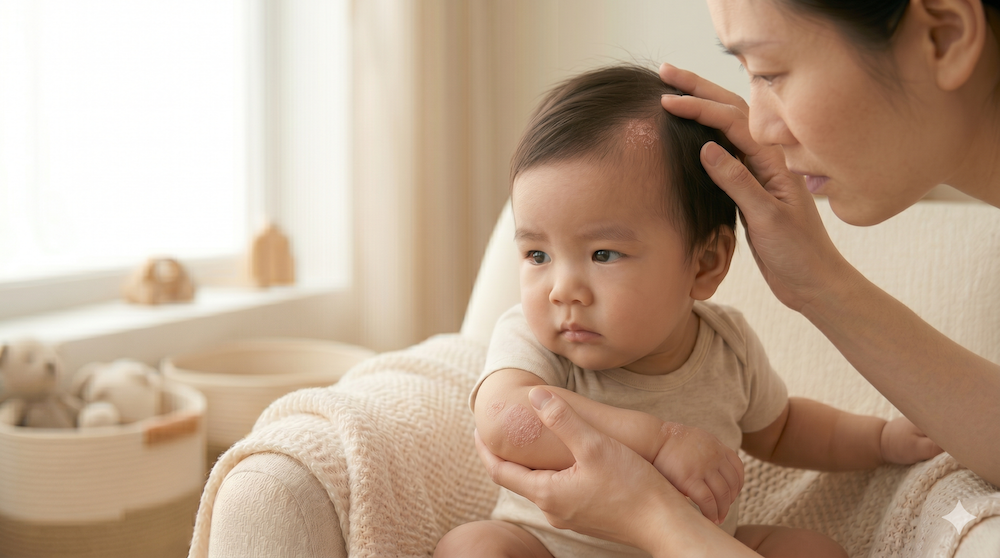
Parent checking baby eczema symptoms on the scalp and elbow.
Eczema varies from baby to baby, so knowing how to recognise it at home makes a real difference. The signs and locations help parents act quickly.
What does baby eczema look like?
The symptoms of eczema appear as skin changes that are dry, inflamed, and persistently itchy. Look for:
- Dry, rough, or scaly patches of skin.
- Redness and swelling. On darker skin tones, patches may appear brown, purple, or grey. Texture is often a more reliable indicator than colour.
- Small bumps that may ooze or crust when scratched.
- Thickened or leathery skin from prolonged scratching.
Watch for behavioural signs too. Your baby may scratch more than usual, have disturbed sleep, or become fussy during bathing or dressing.
Where does eczema appear on babies?
The location shifts as your baby grows. Under 6 months, it tends to appear on the cheeks, forehead, and scalp. From 6 to 12 months, it often moves to the elbows, knees, and areas that come into contact with the floor during crawling.
In toddlers, the elbow creases, behind the knees, wrists, ankles, and around the eyes and mouth are the most common spots.
Eczema rarely appears in the nappy area, which is a useful distinction from nappy rash.
Read: Nappy Rash (Diaper Rash): What is it, Symptoms, & Causes.
Eczema vs rash: How to tell them apart
Several common skin conditions look similar to eczema. Here is how to tell them apart.
- Heat rash: Tiny red bumps caused by blocked sweat glands. Common in Malaysia's warm, humid climate. Clears with cooling and breathable clothing.
- Cradle cap (seborrhoeic dermatitis): Greasy, yellowish scales on the scalp. Not itchy and not eczema. Usually clears by 12 months.
- Viral or passing rash: Appears suddenly alongside a fever or illness, and clears within days. Eczema is persistent and keeps returning in the same locations.
If the same inflamed patch keeps returning, it is more likely eczema. A paediatrician can confirm.
What causes eczema and what triggers flare-ups?

Common baby eczema triggers including detergent, fabrics, allergens and dry air.
Understanding what causes baby eczema starts with the skin barrier. It is genetic at its root, but flare-ups are almost always triggered by environmental factors.
Genetics and the skin barrier
Baby eczema tends to run in families. If a parent or sibling has eczema, asthma, or hay fever, the baby is more likely to develop it. The underlying cause is a defective skin barrier that loses moisture easily and lets irritants in. It is not caused by anything you did or did not do.
Common eczema triggers in babies
While the cause is genetic, environmental factors trigger or worsen flare-ups. The most common ones to watch for:
- Dry air and low humidity: Particularly in air-conditioned environments, which are common throughout Malaysia. Low humidity accelerates moisture loss from already-compromised skin.
- Irritants: Fragranced soaps, detergents containing optical brighteners, and rough fabrics like polyester or wool trigger inflammation on sensitive skin.
- Heat and sweat: Overheating causes perspiration that irritates inflamed skin. Breathable cotton and a cool sleeping environment help.
- Saliva and drool: A common trigger around the mouth and chin in younger babies. A barrier balm applied before feeds protects the skin.
- Allergens and illness: Dust mites, pet dander, and pollen are common triggers. Being unwell or overtired can also worsen flare-ups.
A simple diary of products, foods, weather, and flare timing usually reveals patterns within two to three weeks.
How to manage baby eczema naturally

Parent moisturising a baby after bathing to help manage eczema.
Eczema treatment at home works as a connected daily system, not a checklist of separate tips. Each step protects what the previous one builds. Bath time hydrates the skin barrier, moisturising within 3 minutes seals that hydration before it evaporates, and fragrance-free laundry ensures nothing sitting against the skin undoes the work. Miss one step consistently and the others lose their effect. For severe or persistent cases, consult a paediatrician or dermatologist.
The gentle bathing routine
Bath time is critical. The correct method hydrates the skin barrier; the wrong method strips it.
- Use lukewarm water only: around 37 degrees Celsius. Hot water inflames sensitive skin.
- Keep baths short: 5 to 10 minutes. Long baths over-strip the skin's natural oils.
- Use a mild, fragrance-free, soap-free wash: Avoid harsh surfactants, synthetic fragrance, and optical brighteners, which are among the most common eczema triggers.
Offspring Gentle Head-To-Toe Wash is soap-free, formulated with aloe vera, calendula, and chamomile. It is Australian Allergy Certified and dermatologist and paediatrician approved for sensitive skin.
For the full soak-and-seal technique, read: The 3-Minute Rule for Eczema: How to Bathe and Moisturise Your Baby for Instant Relief.
Moisturising: The single most important step
Moisturising is the cornerstone of eczema management. It repairs the skin barrier, locks in hydration, and reduces flares. Regular moisturising is one of the most important steps in managing eczema in children.
- Apply at least twice daily: once after bathing, and at least once more during the day. More often during flare-ups.
- Moisturise within 3 minutes of bathing: while skin is still damp. Absorption is highest at this point.
- Choose fragrance-free, thicker creams: over thin lotions. Thicker formulas create a stronger, longer-lasting barrier.
- Cover the whole body: not just affected areas. Full-body moisturising is the most effective eczema prevention between flares.
Offspring Nourishing Baby Lotion is enriched with 6 natural botanical extracts, non-greasy, certified organic, and hypoallergenic from newborn. For flare-prone areas such as cheeks, chin, and skin folds, a barrier balm applied before feeds or sleep adds a targeted layer of protection. Offspring Soothing Nappy Balm is dermatologist-tested for eczema-prone skin and made with 94.4% organic ingredients.
Laundry and clothing choices
Clothing and laundry matter as much as skincare. Fibres, detergent residues, and optical brighteners sit against your baby's skin all day.
- Soft, breathable cotton only: Avoid wool, polyester, and synthetic blends. These trap heat and irritants against sensitive skin.
- Pre-wash all new clothing and bedding: before first use. New garments can contain manufacturing residues.
- Use a fragrance-free, plant-based laundry wash: Optical brighteners and synthetic fragrances in conventional detergents remain on fabric after washing.
- Keep the sleeping environment cool: around 20 to 22 degrees Celsius. Overheating is a common night-time trigger.
Offspring Plant-Based Laundry Wash is free from optical brighteners and synthetic fragrance, uses natural eucalyptus oil, and is gentle on eczema-prone skin and fabrics.
When to see a paediatrician or dermatologist
Most cases respond well to consistent home care. See a paediatrician or dermatologist if:
- Eczema does not improve after one to two weeks of consistent home care.
- The rash is spreading, severe, or covering large areas.
- There are signs of infection: oozing, crusting, pus-filled blisters, increased redness, or fever.
- Your baby is very itchy, distressed, or unable to sleep.
- You suspect a food allergy or environmental trigger you cannot identify.
Trust your instincts when something is not improving. A paediatrician or dermatologist can find the right approach for your baby's specific skin.
FAQs: Baby eczema
What is the difference between eczema and atopic dermatitis?
They are the same condition. Atopic dermatitis is the medical name for the most common type of eczema in babies, and the two terms are used interchangeably.
Can baby eczema be managed without steroids?
Yes, in many cases. Consistent moisturising, trigger avoidance, and gentle skincare can effectively control mild to moderate eczema. A paediatrician can advise if stronger treatment is needed.
What laundry detergent is safe for eczema-prone skin?
Choose a fragrance-free, plant-based laundry wash free from optical brighteners and synthetic dyes. Conventional detergents leave residues on fabric that can trigger flare-ups.
Is it safe to bathe a baby with eczema every day?
Yes. Daily bathing followed immediately by moisturising is recommended. The bath hydrates the skin; the moisturiser seals that hydration in. Skipping baths does not help.
Will my baby outgrow eczema?
Many children do. Around 60% see significant improvement by school age. Consistent gentle care reduces severity at any age and supports the skin barrier as it matures.
Conclusion
Baby eczema is a common condition that affects up to 25% of children worldwide. It is chronic, but it is manageable. The key is consistency: a gentle daily routine covering bathing, moisturising, and laundry keeps the skin barrier supported and reduces flare frequency over time. With the right daily habits and consistent gentle care, eczema is something most babies can live with comfortably.
Explore Offspring's gentle bath and skincare range formulated for sensitive and eczema-prone skin. For personalised guidance, get in touch with the Offspring team.


