
Key takeaways
- A baby's clothing and bedding are in contact with their skin for most of the day and night. Whatever remains in the fabric after washing stays in repeated contact with the skin.
- Conventional detergents may contain optical brighteners, synthetic fragrance, SLS, phosphates, and formaldehyde-releasing preservatives, all of which can trigger skin reactions in sensitive babies.
- A chemical-free baby laundry detergent should be free from optical brighteners, synthetic fragrance, SLS and SLES, phosphates, and formaldehyde-releasing preservatives.
- Washing technique matters as much as the detergent itself. An extra rinse cycle, correct dosage, and washing baby clothes separately all reduce the residue that stays in fabric.
Introduction
You have changed the wipes, the baby wash, and the skincare. The laundry detergent is still the same one you have always used. Everything your baby wears sits against their skin all day and all night, washed in whatever that detergent leaves behind. This guide covers why laundry detergent is an overlooked skin trigger, which ingredients to avoid, what plant-based cleaning agents do differently, what to look for in a chemical-free option, and how to wash correctly to protect sensitive skin.
For eczema skincare and wipe guidance, read: Best Baby Wipes That Are Safe for Newborns with Eczema? Everything You Need to Know, and Comprehensive Guide to Managing Baby Eczema Naturally.
Why baby laundry detergent is an overlooked trigger for baby skin reactions

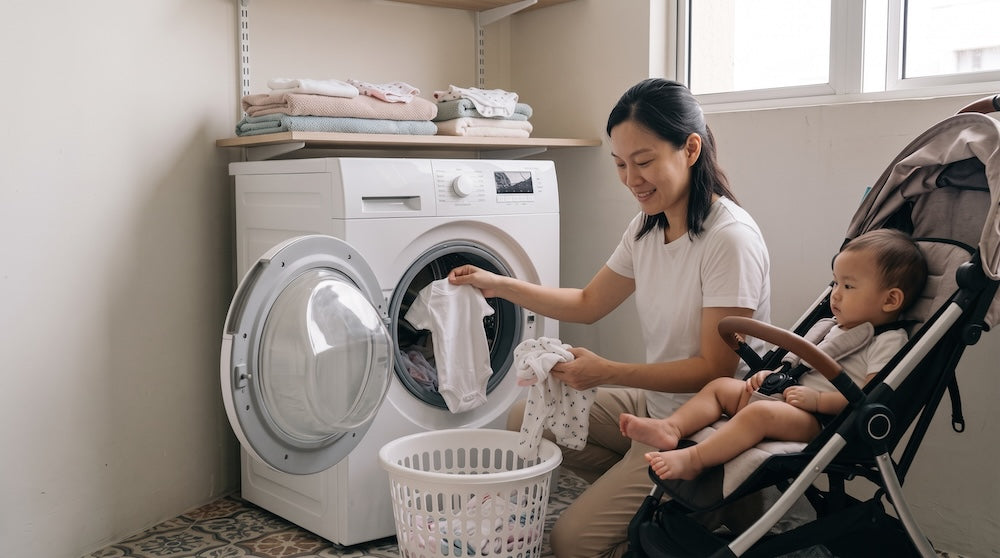
Mum doing laundry with baby in stroller nearby.
Most parents focus on what goes on their baby's skin, but what the baby wears is in contact with their skin for just as long.
Clothing is in contact with baby's skin all day. A baby's clothing, bedding, and cloth items are in contact with their skin for most of the day and night, which means whatever remains in the fabric after washing is in repeated contact with the skin at every wear.
Residue from detergent stays in fabric. Conventional laundry detergents can leave residue in fabric fibres after washing, creating a repeated daily exposure to the same ingredients for babies with sensitive or eczema-prone skin.
Sensitive baby skin reacts differently. A baby's skin is thinner than adult skin and more sensitive to repeated contact with fabric residue, which means ingredients that remain in fabric can have a greater effect on a baby than on an adult.
In Malaysia's warm and humid climate, dressing and changing throughout the day increases the total exposure to whatever remains in the fabric. Laundry detergent is not just a cleaning product. For sensitive skin, it is part of the daily routine that either supports or affects the skin.
What conventional baby laundry detergents contain
Detergents marketed as baby-safe or gentle may still contain ingredients that cause skin reactions in babies with sensitive skin.
- Optical brighteners. Chemicals added to make white fabrics appear brighter. They coat fabric fibres and remain in the cloth after washing, staying in contact with baby's skin at every wear.
- Synthetic fragrance. Added to make clothes smell fresh after washing, fragrance ingredients can remain in fabric and are one of the most common causes of allergic contact dermatitis, including in babies with sensitive skin.
- SLS and SLES. Sodium lauryl sulphate (SLS) and sodium laureth sulphate (SLES) are common cleaning agents in conventional detergents. For babies with sensitive skin, these surfactants can be too harsh for the repeated fabric-to-skin contact that happens throughout the day.
- Phosphates. Added to soften water and improve cleaning performance, phosphates are restricted in many markets due to environmental concerns but still appear in some baby-specific detergents.
- Formaldehyde-releasing preservatives. Some conventional detergents contain preservatives that release small amounts of formaldehyde over time. Formaldehyde is associated with contact sensitivity, and repeated low-level exposure through fabric contact is worth avoiding for sensitive skin.
For a baby with sensitive or eczema-prone skin, a good starting point is a detergent free from optical brighteners, synthetic fragrance, SLS and SLES, phosphates, and formaldehyde-releasing ingredients.
What plant-based cleaning agents do differently in a baby laundry wash
Cleaning agents are what lift dirt and stains from fabric in any laundry detergent.
What cleaning agents in laundry detergent do. Cleaning agents work by attaching to both water and dirt simultaneously, allowing dirt to be lifted from fabric and rinsed away. Water alone cannot remove oils, food stains, or body soils.
What makes plant-based cleaning agents different. Plant-based cleaning agents are derived from natural sources such as coconut oil rather than petroleum, and are designed to biodegrade more easily after use.
Why this matters for baby laundry. Plant-based cleaning agents are designed to be gentler on fabric and on the skin that fabric touches. This is the design intent behind plant-based surfactants, not a guarantee that every product delivers this automatically.
Offspring Plant-Based Baby Laundry Wash is formulated with over 50% biobased surfactants including natural coconut-derived surfactants, making the formula 100% biodegradable.
What to look for in a chemical-free baby laundry detergent
Offspring plant-based baby laundry wash bottle.
Choosing a laundry detergent for a baby with sensitive or eczema-prone skin comes down to what the formula contains and what it does not. In practice, chemical-free simply means the formula uses plant-derived ingredients and leaves out anything that can irritate sensitive skin. That is what to look for on any label.
- Free from optical brighteners, synthetic fragrance, SLS, phosphates, and formaldehyde. A clean label for baby laundry means none of these five ingredients. Parents can verify this on the packaging or the brand's website.
- Plant-based cleaning agents. Look for terms like "biobased surfactants," "non-ionic surfactants," or "coconut-derived" on the label. These indicate plant-derived cleaning agents rather than petroleum-derived synthetic chemicals.
- Biodegradable formula. A biodegradable formula breaks down naturally after use, which is safer for greywater systems and the environment. Biodegradability is a straightforward label claim to verify.
- Certified non-toxic and cruelty-free. Independent certifications give parents third-party verification beyond self-declared marketing claims.
Offspring Plant-Based Baby Laundry Wash uses a 4X concentrated formula with four bio-based surfactants, made from over 50% biosurfactants and 100% biodegradable ingredients, and is free from 46 nasties. It holds Australian Allergy Certified, Made Safe certification, Non-toxic Certified, and PETA Cruelty-Free and Vegan certifications.
Washing tips to protect baby's skin every wash

5 washing tips for baby's sensitive skin infographic.
Choosing the right detergent is the first step. How the laundry is washed matters too.
- Use the correct amount of detergent. Using more than recommended does not mean cleaner clothes. Excess detergent may not rinse out fully, leaving more residue in the fabric. Offspring Plant-Based Baby Laundry Wash recommends 40 to 80ml per load.
- Add an extra rinse cycle. An extra rinse cycle helps remove more detergent residue from fabric after washing. For babies with very sensitive or eczema-prone skin, this simple step reduces the amount of detergent that stays in contact with the skin.
- Wash baby clothes separately. Washing baby clothes separately from adult laundry avoids cross-contamination from any adult detergent residue still in the machine drum. A short drum clean between loads is a simple precaution.
- Wash new clothing before first use. New clothing often contains manufacturing chemicals not listed on the label. Washing new items before the first wear helps reduce these residues before they contact baby's skin.
- Choose the right wash temperature. Very high temperatures can break down fabric fibres over time. For everyday baby laundry, a warm cycle protects both the fabric and any care labels.
For the bathing routine that works alongside clean baby laundry for eczema skin, read: The 3-Minute Rule for Eczema: How to Bathe and Moisturise Your Baby for Instant Relief.
When to see a doctor about skin reactions from laundry products
If a baby develops persistent skin reactions that do not improve after switching to a chemical-free laundry detergent, it is worth speaking to a doctor or paediatrician.
Signs that need professional attention. Redness, rash, or irritation that spreads or does not clear up within a few days of switching products warrants a paediatrician visit to identify whether the cause is an ingredient, an environmental trigger, or a deeper skin issue.
Patch testing for known allergies. A doctor may recommend patch testing to identify specific ingredient triggers if a baby shows repeated reactions. This is a process a doctor arranges to pinpoint the cause.
Eczema diagnosis and management. If skin reactions are not managed by product changes alone, a paediatrician or skin specialist can provide a diagnosis and a management plan that covers the full routine.
FAQs: Chemical-free baby laundry detergent
Do I need a separate laundry detergent for baby clothes?
For babies with sensitive or eczema-prone skin, yes. A detergent free from optical brighteners, synthetic fragrance, SLS, phosphates, and formaldehyde-releasing preservatives is worth the switch. Offspring Plant-Based Baby Laundry Wash is free from all five.
What ingredients should I avoid in a baby laundry detergent?
Optical brighteners, synthetic fragrance, SLS and SLES, phosphates, and formaldehyde-releasing preservatives such as quaternium-15.
Are plant-based baby laundry detergents as effective as regular ones?
Yes. Plant-based cleaning agents lift soils from fabric by the same mechanism as synthetic ones. The difference is in what they are derived from and how they biodegrade, not in cleaning performance.
Which baby laundry detergent is safe for eczema-prone skin?
Offspring Plant-Based Baby Laundry Wash is a strong option. It is free from 46 nasties including SLS, SLES, synthetic fragrance, optical brighteners, phosphates, and formaldehyde-releasing preservatives. It holds Made Safe certification, Non-toxic Certified, and PETA Cruelty-Free and Vegan, and is formulated with 100% biodegradable, plant-derived surfactants.
Can I use baby laundry detergent for the whole family?
Yes. Offspring Plant-Based Baby Laundry Wash is formulated with babies in mind but is effective for everyday adult laundry too. It is free from synthetic fragrance, optical brighteners, SLS, phosphates, and formaldehyde-releasing preservatives, making it suitable for the whole family.
How many loads does one bottle of baby laundry wash last?
The Offspring Plant-Based Baby Laundry Wash 1-litre bottle lasts approximately 25 washes at the recommended dosage of 40 to 80ml per load.
Conclusion
Laundry detergent is the last product most parents change, but for a baby with sensitive or eczema-prone skin, what washes the clothes matters as much as what goes on the skin. A chemical-free, plant-based formula avoids the ingredients that create residue risk in the first place, and the right washing technique removes as much as possible of what remains.
Explore Offspring Plant-Based Baby Laundry Wash and make it part of your baby's daily skin routine.


