
Key takeaways
- Baby acne (neonatal acne) affects around 20% of newborns and is one of the most common skin conditions in the first weeks of life.
- It appears as small red or pink bumps on the cheeks, nose, and forehead, and is completely harmless.
- It is triggered by maternal hormones passed to the baby before birth, not by poor hygiene, diet, or anything the parent did.
- No treatment is needed as baby acne clears on its own within a few weeks to a few months.
- If spots appear after 6 weeks, spread, or show signs of infection, speak to your paediatrician.
Introduction
Baby acne, also known as neonatal acne, is one of the most common newborn skin conditions in the first weeks of life, and it is completely harmless. Seeing small red bumps on your newborn's face can worry any parent, but it is not caused by anything you did or did not do, and it clears up on its own.
In this article, we cover what baby acne is, what it looks like, what causes it, how it differs from other common newborn skin conditions, how to care for your baby's skin gently, and when to see a doctor.
What is baby acne?

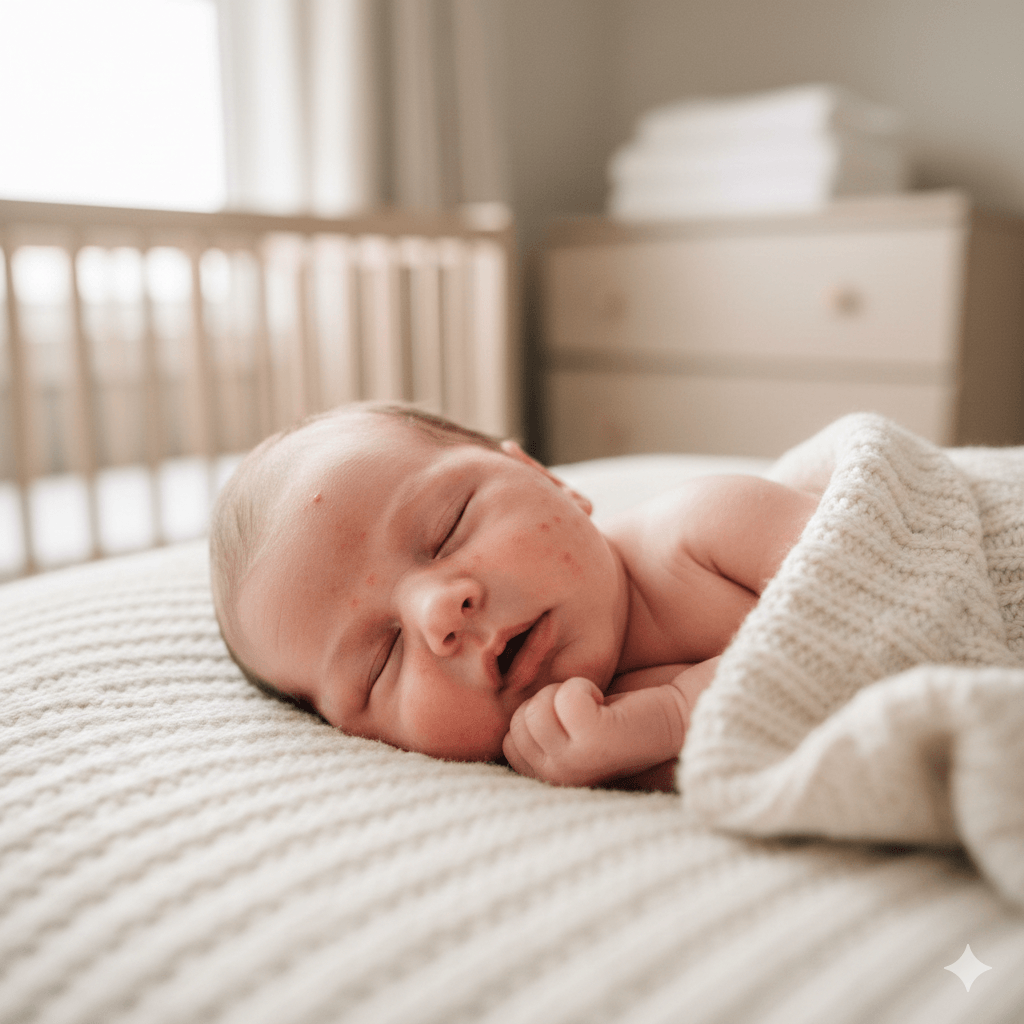
Sleeping newborn with mild baby acne visible on cheeks and nose.
If you are wondering whether baby acne is normal — it is. Also called newborn acne or neonatal acne (medically known as neonatal cephalic pustulosis, or NCP), it is one of the most common skin conditions in early infancy, affecting around 20% of newborns globally. You'll see lots of babies with it across Singapore, Malaysia, and Indonesia too. It is harmless and temporary, and clears on its own without treatment or scarring. Here is what to know:
- It typically appears within 2 to 4 weeks of birth, always before 6 weeks of age.
- It shows up most often on the cheeks, nose, and forehead.
- It clears on its own, usually within weeks, and does not leave any scarring.
- It is slightly more common in boys than in girls.
It also helps to know that neonatal acne and infantile acne are two distinct conditions.
Neonatal acne appears before 6 weeks, has no blackheads or whiteheads, and clears on its own within weeks without scarring. Infantile acne appears after 6 weeks, is far less common, may include blackheads and deeper bumps, and can last up to a year or longer with a small risk of scarring if untreated.
If spots appear or worsen after 6 weeks, consult a paediatrician or dermatologist.
Baby acne symptoms

Close-up of mild baby acne on a newborn’s cheeks and nose.
Baby acne is usually easy to identify once you know what to look for. Knowing the signs also helps you tell it apart from other common newborn skin conditions.
What does baby acne look like?
The most common signs include:
- Small red or pink bumps (papules) on the cheeks, nose, and forehead.
- Some bumps may have a white centre (pustules). These are pus-filled inflammatory bumps, not the clogged-pore whiteheads seen in older acne.
- No blackheads or whiteheads, which is one of the clearest ways to tell neonatal acne apart from infantile acne.
- Bumps may look more visible when your baby is crying, warm, or fussy, as increased blood flow brings more colour to the skin.
- On darker skin tones, bumps may appear brown, purple, or violet rather than red or pink. If you are unsure, look at the texture rather than the colour.
Baby acne on the face does not cause itching, pain, or discomfort. If your baby seems bothered by the area, or the skin looks flaky, dry, or inflamed, it may be a different condition, such as eczema or heat rash.
Where does baby acne appear?
Baby acne is most often seen on the cheeks, nose, and forehead. It can also show up on the chin, scalp, neck, back, and chest, but rarely appears on the arms, legs, or nappy area, which is a useful clue when distinguishing it from other rashes.
What causes baby acne?

Illustration showing maternal hormones stimulating oil glands and causing baby acne in newborns.
Baby acne causes trace back to two main factors:
- Maternal hormones: Hormones the baby is exposed to before birth, specifically a mother's hormones that cross the placenta during pregnancy, stimulate the baby's oil glands, leading to increased sebum production and temporarily clogged pores.
- Malassezia yeast: A yeast naturally found on skin. When sebum production increases in newborns, Malassezia can flourish and trigger an inflammatory response, which is why this condition is also referred to as neonatal cephalic pustulosis.
Here is what does not cause baby acne:
- Poor hygiene or not washing your baby's face often enough.
- The breastfeeding mother's diet or formula choice.
- Kissing your baby.
- Anything you did or did not do as a parent.
Baby acne vs other newborn skin conditions
Several common newborn skin conditions look similar to baby acne. Knowing the differences helps you respond correctly and choose the right care.
| Condition | Looks like | Where it appears | Key difference from baby acne |
| Milia | Tiny, firm, white bumps with no surrounding redness | Face, nose, cheeks | White and firm, no inflammation or redness |
| Eczema | Dry, rough, itchy patches, sometimes flaking or oozing | Face, scalp, elbows, knees | Itchy and flaky. Baby acne is not itchy. |
| Heat rash | Tiny red bumps in clusters | Neck, chest, skin folds | Triggered by overheating, not hormones |
| Cradle cap | Yellowish, greasy, or waxy scales | Scalp | Oily and scaly, not bumpy or inflamed |
If you are not sure which condition your baby has, a paediatrician can easily tell the difference at a routine visit.
For a deeper guide on identifying and managing baby eczema, read Baby Eczema: Symptoms, Treatment, Prevention.
Baby acne treatment and skincare

Simple baby acne care routine with gentle cleansing and skin protection tips.
Wondering how long does baby acne last? In most babies, it clears on its own within a few weeks, though some cases can take up to 3 to 4 months. No medical treatment is needed. Gentle, consistent skincare is all that is required. Never use teenage or adult acne products on a newborn, as these are far too harsh for skin this new and delicate.
Gentle daily cleansing
Wash your baby's face once daily with lukewarm water and a mild, fragrance-free cleanser. Pat the face dry with a soft cloth afterwards. Never rub, and avoid any scrubbing or pressure on the affected areas.
For a gentle option, Offspring Gentle Head-To-Toe Wash works well.
What to avoid?
When caring for a baby with acne, less is always more.
Keeping baby's environment gentle
Clothing and bedding sit against your baby's skin all day, so what you wash them with matters.
When to see a doctor?
Most baby acne resolves on its own with simple home care.
Conclusion
Baby acne is a common, harmless, and temporary condition.


